
Table of Contents
The previous blog has covered the premise of designing industrial plants, the troubles of the old ways, and how CAD revolutionized efficiency, precision, and safety. However, it is only the beginning to know the essence of benefits of CAD. The potential of CAD reveals itself when this technology is used in all stages of the life of a plant, including its planning and operation, and when it is supplemented with such innovative technologies as BIM, IoT, and digital twins. Here, we will learn more in-depth about how CAD assists every part of project delivery, the most popular software that is used in the field, actual cases, and tendencies that will dominate the future of the industrial plant design.
How CAD Enhances Efficiency at Every Stage
The benefits of CAD are not limited to the design phase alone. CAD plays a critical role throughout the entire life cycle of an industrial plant, from planning to operation.

CAD enhances the design at every stage
Planning Stage
In the earliest stage of a project, CAD helps engineers:
- Conduct site analysis and optimize land usage
- Create early conceptual layouts for stakeholder review
- Quickly visualize multiple design options
- Identify environmental and safety constraints early
- Speed up the initial approval process
Design Stage
During detailed design development, CAD supports:
- Precise modeling of all plant systems
- Quick modifications based on client feedback
- Seamless collaboration between multiple engineering disciplines
- Integration of structural, mechanical, electrical, and process designs
- Clash detection to prevent costly conflicts
Construction Stage
During construction, CAD models provide:
- Accurate construction drawings for on-site teams
- Fabrication-ready details for equipment and piping manufacturers
- Real-time access to updated models for all contractors
- Reduced chances of mistakes or misinterpretation
- Fewer delays and smoother project execution
Operation Stage
Even after the plant is up and running, CAD remains useful:
- Helps maintenance teams locate equipment and systems quickly
- Simplifies troubleshooting by providing detailed system maps
- Supports upgrades and future expansions with existing digital models
- Provides a complete historical record for asset management
Commonly Used CAD Software
The design of industrial plants involves software capable of manipulating complicated systems and a huge amount of data, as well as integrating various disciplines in collaboration. Several CAD tools have won the favor of the industry due to their features, flexibility, and capability to enhance efficiency. The following are the most popular CAD software packages in industrial plant design.
Did You Know?
CAD Model Integration Takes Up to 85% of Plant Design TimeIndustry surveys reveal that 43% of engineers spend 1-3 hours and 34% spend more than a full day simplifying equipment models for plant integration, with equipment assemblies comprising up to 85% of total plant design models.
AutoCAD Plant 3D
One of the most popular selections of industrial plant designers is AutoCAD Plant 3D, which is based on the reliable AutoCAD platform, yet extends it with plant-design-specific tools.
Key features:
- 3D modeling of piping, equipment, and structural systems
- Creation of intelligent piping and instrumentation diagrams (P&ID)
- Automatic generation of isometric piping drawings
- Integration with project databases for data consistency
- Built-in clash detection tools
- Easy collaboration between disciplines
Autodesk Revit
Revit is primarily within the building industry, but has been recently expanding into industrial facilities where architecture, structure, and MEP (Mechanical, Electrical, Plumbing) systems need to be completely integrated.
Key features:
- Full Building Information Modeling (BIM) capabilities
- 3D parametric design helps in monitoring real-time updates
- Precise coordination between mechanical, electrical, structural, and architectural models
- Scheduling tools for materials, quantities, and costs
- Integration with Autodesk cloud platforms for remote collaboration
SolidWorks
SolidWorks is known for mechanical design and is used to model the equipment that will be installed inside industrial plants.
Key features:
- Highly detailed 3D mechanical modeling
- Assembly simulations to ensure equipment fits and operates correctly
- Motion analysis for checking equipment performance
- Stress and load analysis for mechanical safety
- Integration with plant layout software for space planning
PDMS (Plant Design Management System) by AVEVA
PDMS is one of the most comprehensive plant design tools used for very large, highly complex industrial plants such as refineries and power plants.
Key features:
- 3D modeling of complete plant layouts
- Support for piping, structural steel, electrical systems, and HVAC
- Multi-user collaboration across global teams
- Real-time clash detection and rule-based design validation
- Full integration with procurement, scheduling, and construction management
Bentley Open Plant
Bentley’s Open Plant platform offers flexible plant design solutions with strong data management capabilities.
Key features:
- Intelligent 2D and 3D modeling tools
- Piping and instrumentation diagram (P&ID) generation
- Integrated data management across the plant lifecycle
- Interoperability with other Bentley and third-party applications
- Scalability for both small and large projects
Case Studies of CAD in Industrial Plant Design
Understanding how CAD works in theory is important, but seeing its real-world applications makes the benefits much clearer. Here are some actual examples of how CAD helped companies complete complex plant design projects.
Pharmaceutical Manufacturing Plant
A leading pharmaceutical company needed to design a new facility for vaccine production, requiring precise environmental controls and tight regulatory compliance.
Challenges faced:
- Strict FDA and GMP compliance requirements
- Complex cleanroom layouts for contamination control
- Space constraints for equipment placement
- Rapid design approval is needed to meet production deadlines
How CAD helped:
- 3D modeling allowed visualization of cleanrooms and equipment layouts
- Clash detection prevented conflicts between HVAC, piping, and electrical systems
- Detailed 2D drawings helped speed up government approval processes
- Collaborative design allowed multiple teams to work simultaneously on different plant sections
The plant was completed ahead of schedule, fully compliant with health regulations, and ready for immediate operation.
Oil Refinery Expansion
An oil company needed to expand an existing refinery to boost capacity without shutting down current operations.
Challenges faced:
- Limited available space for new equipment
- Integration with complex existing systems
- High safety standards due to flammable materials
- Avoiding disruption of ongoing operations
How CAD helped:
- PDMS was used to build a highly detailed 3D model of the entire refinery
- Simulations confirmed that new structures would not overload existing supports
- Piping conflicts were resolved early through clash detection
- Digital models enabled the precise pre-fabrication of the piping module.
Food Processing Plant Upgrade
A food manufacturer needed to upgrade its plant to support new product lines while maintaining production of existing items.
Challenges faced:
- Maintaining hygiene standards during upgrades
- Re-routing existing utilities while keeping production running
- Limited floor space for new equipment
How CAD helped:
- 3D models were used to carefully plan new equipment placement
- Utility rerouting was simulated digitally before any physical work began
- Construction sequencing was optimized to avoid production downtime
- Maintenance access routes were planned to support long-term operations
CAD Integration with Other Technologies
Even though CAD is potent in and of itself, it reaches its true potential when combined with other cutting-edge technologies. Plant design is no longer a vacuum-packed activity nowadays. It encompasses the cooperation of several digital tools in ensuring better accuracy, efficiency, and overall performance of the plant in the long run.
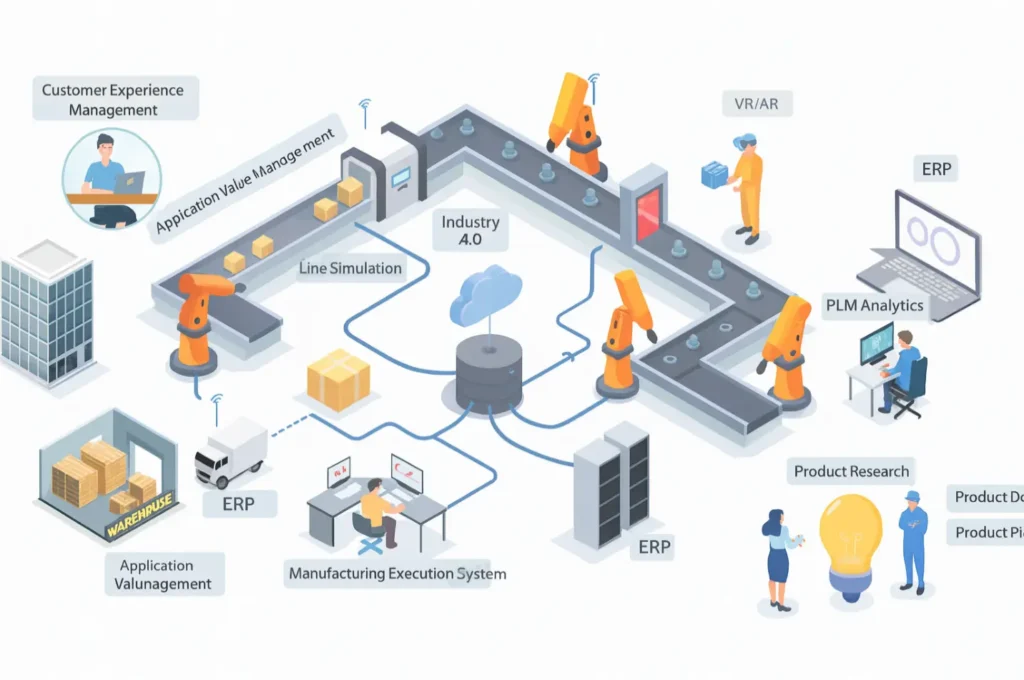
CAD integration with other technologies
Building Information Modeling (BIM)
BIM helps the owners of industrial plants to possess a full digital image of the facility that can be referred to for future expansions, maintenance scheduling, and safety audits. BIM extends CAD beyond the basic drawing and models and incorporates data and intelligence in each component.
Benefits:
• Complete 3D coordination of architectural, structural, and MEP systems
• Real-time Inter-disciplinary collaboration
• Correct estimation of material quantities and cost
• Conflict resolution and clash identification at an early stage
• Design to operation lifecycle data management
Internet of Things (IoT)
The integration of IoT technology transforms the previously lifeless CAD models into digital twins that are living and allow plant managers to make wise decisions using up-to-date information. IoT combined with CAD creates the potential for real-time monitoring of a plant and its performance optimization.
Benefits:
- CAD models can include sensors and devices during the design stage
- IoT devices collect live data on equipment performance, energy usage, and safety parameters
- Real-time data can be mapped back to the CAD model for predictive maintenance
- Helps in optimizing operations based on actual plant conditions
Did You Know?
BIM-IoT Integration Can Reduce Building Carbon Emissions by 50%Digital twins integrated with BIM and IoT technologies can reduce a building’s carbon emissions by up to 50% while improving operational and maintenance efficiency by 35% through real-time monitoring and optimization
Digital Twins
The digital twin begins with the accurate 3D model created by CAD. Without CAD, the digital twin would not exist. A digital twin is a virtual replica of a physical plant that updates as conditions change in real-time.
Benefits:
- Real-time monitoring of plant operations
- Predictive maintenance by identifying problems before failures occur
- Simulation of future scenarios for process optimization
- Cost savings through better resource management
Did You Know?
Digital Twins Market Expected to Reach €240 Billion by 2032The global digital twin market is projected to grow from €16.55 billion in 2025 to €242.11 billion by 2032, with a compound annual growth rate of 39.8%, driven largely by manufacturing and industrial applications – SOURCE
Artificial Intelligence (AI) and Machine Learning
By integrating AI with CAD, plant design can become smarter, faster, and more responsive to changing business needs. AI is starting to play a role in optimizing plant designs by analyzing vast amounts of data.
Applications include:
- Automated design suggestions based on historical project data
- Energy usage predictions to create more efficient layouts
- Equipment placement optimization for better workflow
- Safety analysis through simulation of emergency scenarios
The Future
The future of industrial plant design is brightly linked with the continued development of CAD technology. So, what is next and what will it bring to the industry? Let us find out.
Cloud-Based Collaboration
International teams are now able to collaborate as though they were in the same place, accelerating design cycles and limiting errors introduced by version mismatches. Cloud-based CAD is shifting this requirement of powerful local machines that was hitherto necessitated by traditional CAD systems.
• Collaboration in real time between remote teams
• Access most up-to-date project files instantly
• Lower hardware prices and upgraded software at the touch of a button
• Increased security of data due to centralisation of storage
Automation
Automation decreases the manual workload, enhances precision, and enables engineers to concentrate on solving complicated tasks rather than menial duties. CAD systems also include more and more automation capabilities to deal with repetitive procedures.
- Automatic laying out of pipes and conduits
- Clash auto detection
- On-the-spot creation of material lists and cost estimates
- Design rule check performs a check on the code
Advanced Simulation
Simulations also allow plant designers to discover the possible issues that may occur even before they happen, resulting in safer and more efficient designs. Simulators are getting more comprehensive and are available even within CAD environments.
- Stress, thermal, and fluid flow analysis in real time.
- Process simulations to optimise production
- Real-time simulations of emergency scenarios such as fires or equipment failure
Green Design and Sustainability
The sustainable design not only conserves the environment but also saves the plant owners money in the long-term operational costs. The design of industrial plants is changing due to environmental concerns.
- Modelling of energy consumption
- Waste analysis reduction
- Management of water and resources
- Environmental regulation laws
Did You Know?
11% of Global Greenhouse Gas Emissions Come From ConstructionAbout 11% of the world’s greenhouse gas emissions from buildings stem from the construction phase – SOURCE
Choosing the Right CAD Partner
While CAD software is powerful, its true value is only realized when managed by skilled professionals who understand both the technology and the specific needs of industrial plant design.
Why Work with Specialized CAD Service Providers
- Access to experienced design teams familiar with industry codes and standards
- Ability to handle large, complex projects with multiple disciplines
- Expertise in integrating various technologies like BIM, IoT, and digital twins
- Faster turnaround times due to streamlined workflows
- Cost savings through optimized resource allocation
What to Look for in a CAD Partner
- Proven track record in industrial plant projects
- Expertise across multiple CAD platforms
- Capability for 3D modeling, clash detection, and simulation
- Strong data management and security protocols
- Transparent communication and collaboration processes
How CAD Services India Can Help
- Accurate 2D and 3D models
- Intelligent P&ID diagrams
- Clash-free designs ready for construction
- Fully coordinated models for multi-disciplinary projects
- Support throughout the entire project lifecycle
Conclusion
CAD has established itself as more than a design tool; it is also a strategic efficiency, collaboration, and innovation accelerator in industrial plant projects. Industrial facilities are to be safe, efficient, and future-proof with significant planning and construction, operation, and upgrades in the future required by CAD. CAD is changing the intelligent design of the future plant with its combination with BIM, IoT, digital twins, and AI. A good relationship with top-quality CAD professionals will enable the business to keep up with the technological trends, minimize risks, and deliver globally superior facilities that can last long.
What is the interaction of CAD when combined with some technologies, such as BIM and IoT?
CAD can fit well with BIM to get a data-rich model, IoT to monitor in real time, and digital twins to predict and achieve optimization of operations.
What evidence can provide real-life case studies about the value of CAD?
CAD case studies indicate that it can decrease project schedules, remove clashes, and assure commissioning within the pharmaceutical manufacturing plants, oil refinery projects, and food processing site upgrading.
What will be new in the future of CAD in industrial plants?
The latest trends have been seen in cloud-based collaboration, automation of design, advanced simulation, and green design to enhance global sustainability.
What are the ways through which a business can select an appropriate CAD service provider?
Seek out experience within an industry, multi-platform experience with a range of CAD packages, efficient collaboration processes, and a demonstrable track record of high accuracy and compliance with designs.
Ready to Revolutionize Your Industrial Plant Design?
Transform your plant design process with cutting-edge CAD solutions. Tesla Mechanical Designs delivers CAD and 3D Modeling for Industrial Plant Design—contact us today to accelerate your project success!
Get Started