

Table of Contents
The modern economies rely on industrial plants. Whether it is a manufacturing unit and power plant or a chemical processing facility and food production line, industrial plants are essential for fulfilling the rising needs of the world. The task of designing such plants is noteworthy, though. It deals with the planning of complex systems, space management, workers’ safety, and the productivity of operations.
Years back, manual drafting was used in designing plant features which was very labor-intensive, subject to errors, and time-consuming. With industries becoming more and more complex, it became quite evident that a superior solution is required.
Did You Know?
The global CAD market is projected to grow from USD 12.2 billion in 2025 to USD 22.7 billion by 2035, at a compounded annual growth rate of 6.4 % – SOURCE
CAD has brought a revolution in the way industrial design is being undertaken today. Designers, engineers, and plant owners may obtain a high degree of efficiency, accuracy, and flexibility by utilizing CAD technology. In this blog, we are going to have a closer look at how CAD has revolutionized the design of industrial plants, its advantages, the tools that are typically used, and the perspectives of this fascinating area.

Industrial Plant Design – 3D Modeling
What is Industrial Plant Design?
Industrial plant design is the planning, laying out, and building of the physical facilities of industrial plants. This consists of all the machinery placements, piping designs, and electrical systems, as well as the ventilation and safety measures. The design shall be able to facilitate the intended production processes of the plant with an assurance that the design is operationally efficient, safe, and regulatory compliant.
Design of industrial plants, in contrast to commercial or residential buildings, is very specialized. It demands a profound comprehension of the industrial procedures, material-handling, safety codes, as well as equipment specifications. Every plant design is a custom design depending on the needs of the industry and the nature of the products that are in production.
Key Elements for Plant Design
Designing an industrial plant involves multiple elements, such as:
- Site layout and space planning
- Equipment placement and machinery alignment
- Material handling systems
- Piping and instrumentation
- Electrical and power distribution
- HVAC (Heating, Ventilation, and Air Conditioning) systems
- Safety features such as fire exits, ventilation, and emergency systems
- Compliance with industry regulations and environmental standards
Did You Know?
The first CAD system, PRONTO, was developed in 1957 by Dr. Patrick Hanratty, laying the foundation for all modern CAD/CAM technologies – SOURCE
Challenges Faced in Traditional Design Approaches
Before CAD, plant design relied heavily on manual drafting. This approach presented several challenges:
- High chances of human error leading to costly mistakes
- Time-consuming revisions and updates
- Difficulty in visualizing complex plant layouts
- Limited collaboration between different teams
- Inefficient communication of design intent to stakeholders
The limitations of manual design methods made it clear that a better solution was necessary. The industry required a system that could handle complexity, enhance accuracy, and facilitate easy modifications. CAD offered exactly that.
The Evolution of Design
Earlier industrial plant designers used to do all the drawing with the help of hand and with the help of drafting tables, rulers, and pencils. Designers created huge sheets of drawings, where each component was to be labeled accurately. If there is any change required, it might be necessary to redo the whole drawing, which would consume hours or even days. There were chances of errors, and a slight error would result in delays that would prove costly in the construction process.
Manual drafting was more and more impractical as industries expanded and the complexity of plants increased. The increased requirement for a quicker, accurate, and versatile design tool was felt.
What is Computer-Aided Design (CAD)?
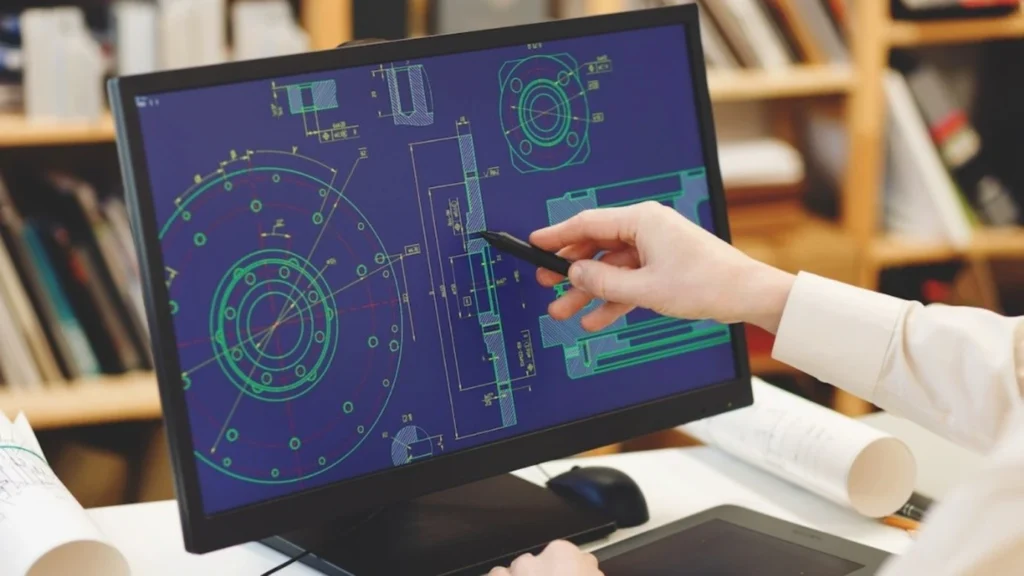
Computer-Aided Design
Computer-Aided Design (CAD) is a computer technology that helps designers and engineers to make precise 2D and 3D models of structures, systems as well and components. It has substituted manual drafting with digital tools, which provide accuracy and control that were hitherto unavailable. When applied to the design of industrial plants, CAD helps designers to produce extremely detailed layouts showing every pipe, every valve, machine, and electrical interconnection.
Early Adoption of CAD in Industry
By the 1980s, CAD software became cheaper and available, and it could enter the industrial design of such spheres as architecture and construction, and industrial plant design. Initially, CAD was spread mainly in 2D drafting. Nevertheless, with the development of software functions, 3D models gained more and more popularity. This changed as plant designers could now develop more realistic modeling, visualize layouts from more angles, and identify conflicts in the design before construction.
Why CAD Became Essential for Industrial Plants
The industrial facilities entail thousands of interlocking systems. One design of piping, electrical routing, or equipment spacing can interfere with operations or cause a safety problem. CAD helps engineers to lay out these systems in a well-coordinated way that is less likely to cause any conflict; hence, the smooth running of the project.
CAD has become an indispensable part of the contemporary industrial plant projects due to the possibility to visualize, modify, and simulate the plant designs.
Benefits of CAD in Industrial Plant Design
CAD does not just make plant design faster. It transforms the entire process by improving accuracy, collaboration, and long-term operational efficiency. Here are some of the major benefits:

CAD use in Industrial Design
Improved Accuracy and Precision
Among the greatest benefits of CAD is the fact that it is extremely accurate. A CAD drawing is mathematically precise in every line, curve, and measurement. This negates the chances of minor measurement mistakes that may end up causing huge problems in the construction or performance stage.
Did You Know?
In 2025, 3D CAD design will account for 74.3 % of the total CAD market share, reflecting its dominance in complex plant layout visualization – SOURCE
In the case of industrial plants, where precise locations of equipment, piping, and electrical systems are of great importance, such accuracy is important to guarantee a perfect fit of all components.
Time Efficiency
Design modifications that previously would have required hours or days to accomplish can now be done in minutes with CAD. In case there is a need to move a piece of equipment or the routes of the piping systems should be changed, designers would be able to perform alterations immediately. Such flexibility helps more rapid design development, more rapid client approval, and abridged project schedules.
Quicker revisions also imply that unexpected issues found near the end of the design process can be resolved swiftly and that construction does not have to be slowed down by unnecessary expenses.
Improved Collaboration
Designing industrial plants often involves the coordination of multiple teams of workers, including process engineers, mechanical designers, structural engineers, and electrical specialists. CAD allows all teams to develop around a single integrated model, which improves coordination and reduces misunderstanding.
The introduction of cloud-based CAD solutions is making teamwork in real-time a reality even when team members are in various locations. This enhances communication, and no one will be working on an outdated design.
Cost Savings
CAD has reduced risks because it is possible to analyze the designs in detail before the construction process starts.
The companies may prevent costly mistakes by simulating and identifying the design conflicts beforehand and optimizing the utilization. This translates into huge savings during the project life.
Better Visualization
The 3D CAD models offer a realistic impression of the appearance of the plant after it has been built. This assists the stakeholders, such as the investors, regulatory authorities, and the clients, in having a better comprehension of the design.
Clarity visualization additionally facilitates the planning of material flow routes, maintenance accessibility, and evacuation routes. The possibility of seeing the whole plant in 3D helps make decisions in the design process.
Safety
Safety is one of the greatest concerns in industrial plants. CAD allows designers to perform safety simulations, evaluate emergency access points, and fulfill the requirements of industry regulations. CAD may lead to safer working environments since potential safety problems may be identified during the design phase, thereby eliminating accidents.
Key Features of CAD
Today, CAD software is not merely line and shape drawing. It is installed with features that enhance precision, efficiency, and dependability in the design of industrial plants. The following are the key CAD functions that industrial plant designers hold to attain improved results.
2D Drafting for Detailed Schematics
Even though 3D modeling is widely used, 2D drafting remains very important for many parts of industrial plant design.
Benefits:
- Creation of precise floor plans, piping layouts, and electrical diagrams
- Accurate placement of components and systems
- Easy to read and interpret for construction teams
- Fast generation of fabrication and assembly drawings
- Helpful for regulatory approvals and documentation.
3D Modeling for Full Visual Representation
3D modeling has transformed how plant layouts are designed and reviewed.
Benefits:
- Visualization of the entire plant structure from all angles
- Better understanding of spatial relationships between systems
- Early detection of design conflicts
- Helps clients and stakeholders visualize the final product
- Aids in planning material handling and workflow routes
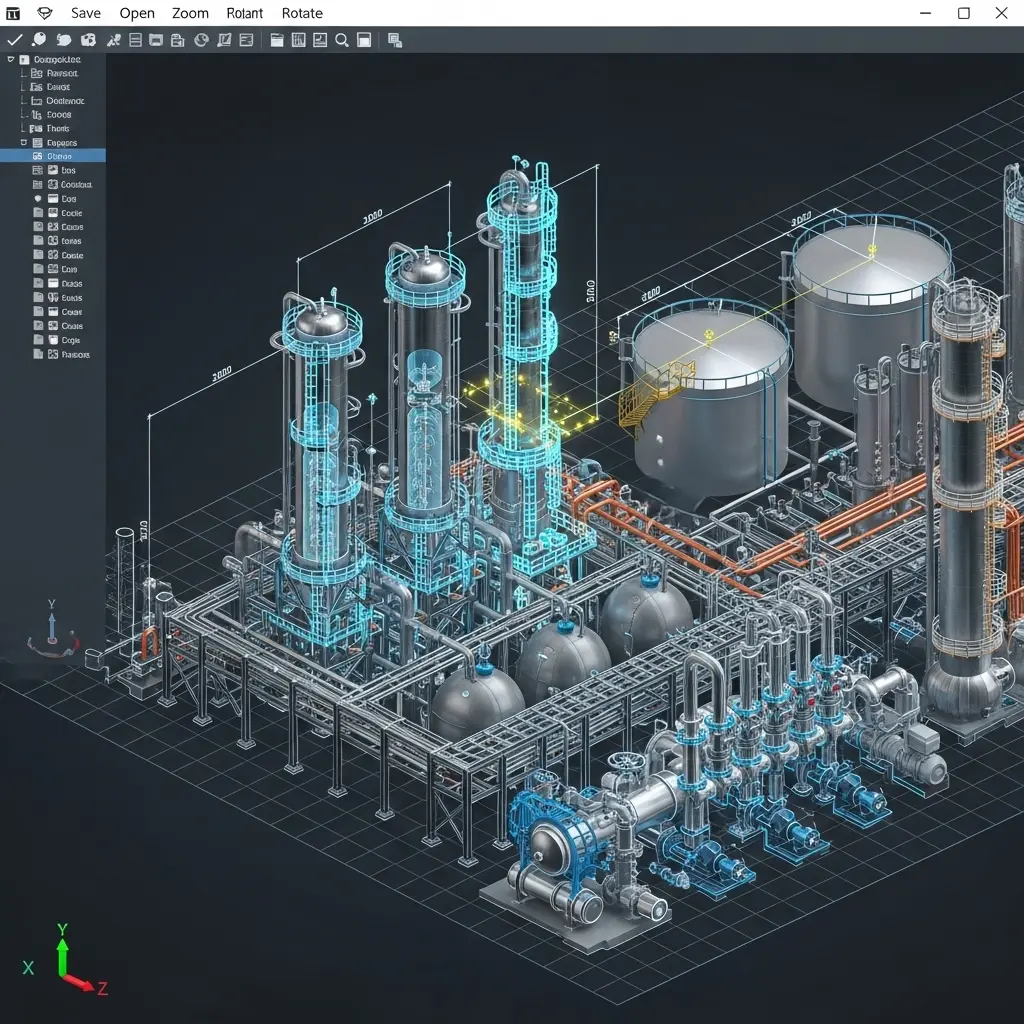
3D CAD Modeling Of Industrial Plant
Piping Diagrams
The piping system is generally a very complicated network in any industrial facility. Plumbing drawings can easily be created using CAD software.
Benefits:
- Shows how pipes, valves, sensors, and instruments are connected
- Serves as a blueprint for construction and operation
- Assists maintenance teams in troubleshooting issues
- Helps with compliance and safety inspections
Clash Detection and Interference Management
Space is often tight in industrial facilities. Systems may run across each other, and small design mistakes can lead to large problems.
Benefits:
- Automatically identifies conflicts between pipes, ducts, and equipment
- Resolves design issues before construction begins
- Prevents costly on-site modifications
- Ensures smooth coordination between different teams
Load Calculations and Stress Analysis
Industrial plants should be designed in a way to handle heavy machinery, high-pressure pipelines, and extreme temperatures.
Benefits:
- Perform structural load analysis to prevent collapses
- Calculate pipe stress under pressure and temperature changes
- Ensure safety and compliance with engineering standards
- Reduce risks of equipment failure or system breakdowns.
Simulation and Performance Prediction
Advanced CAD platforms allow designers to simulate how the plant will function under real conditions.
Benefits:
- Material flow simulations to optimize production
- Energy consumption predictions for better efficiency
- Equipment performance testing under different loads
- Emergency response simulations for safety planning
Documentation and Automated Report Generation
Proper documentation is very, very important for construction, operation, and maintenance.
Benefits:
- Bill of materials for procurement
- Detailed fabrication drawings
- Assembly instructions for construction teams
- Maintenance manuals for long-term operations
- Automated generation of reports and schedules
Summing Up!
The replacement of drafting boards by CAD has changed industrial plant layouts with its capabilities of greater precision, shorter job cycles, and higher safety. Through basic knowledge of CAD and its essential tools, plant designers can design wiser and more efficient plants that have the capabilities to meet the requirements of modern times. But that is just the start- when CAD features are used throughout the plant life cycle and combined with the newer technologies, the effect is magnified. Part 2 will discuss the reasons why CAD helps each phase of industrial work, the most popular software that makes this revolution, and some instances of CAD successes.
What was the reason behind introducing CAD into the plant design?
CAD was introduced to eliminate numerous mistakes, create more accuracy, speed up design procedures, and promote collaboration among various engineering groups.
How does CAD enhance accuracy in designing plants?
CAD develops mathematically accurate drawings and 3D models, so equipment, pipes, and systems will be placed accurately, thus eliminating expensive errors made on construction.
What is 2D drafting versus 3D modeling in CAD?
2D design drafts plans at just the flat level, like floor plans and piping drawings, whereas 3D modeling establishes a realistic display that is useful in visualizing space relations, as well as finding clashes.
Will CAD make the design safer?
Yes, CAD enables the simulation of safety conditions, adherence to safety requirements, and the detection of any hidden danger before the commencement of a structure.
Ready to transform your industrial plant design with state-of-the-art CAD drafting?
SContact Tesla Mechanical Designs today for a free consultation and discover how our expert drafting and MEP solutions can bring precision and efficiency to your next project!
Talk to Experts