

Table of Contents
When designing a new part or product, it’s not enough to think about how it looks or works. You also need to consider how it will be made. That’s where Design for Manufacturing (DFM) comes in. DFM is about making smart design choices early, so your product is easier and cheaper to produce—without sacrificing quality. At Tesla Mechanical Designs, we apply DFM from the start to help our clients avoid costly surprises down the line.
What is DFM?
Design for Manufacturing means designing parts so they’re easy to make. It’s about aligning your design with the manufacturing process right from the beginning. A great design on paper doesn’t always mean it can be made efficiently—or at all. By using DFM, we minimize production costs, reduce waste, shorten lead times, and avoid unnecessary complexity—all while keeping the design’s function and performance intact.
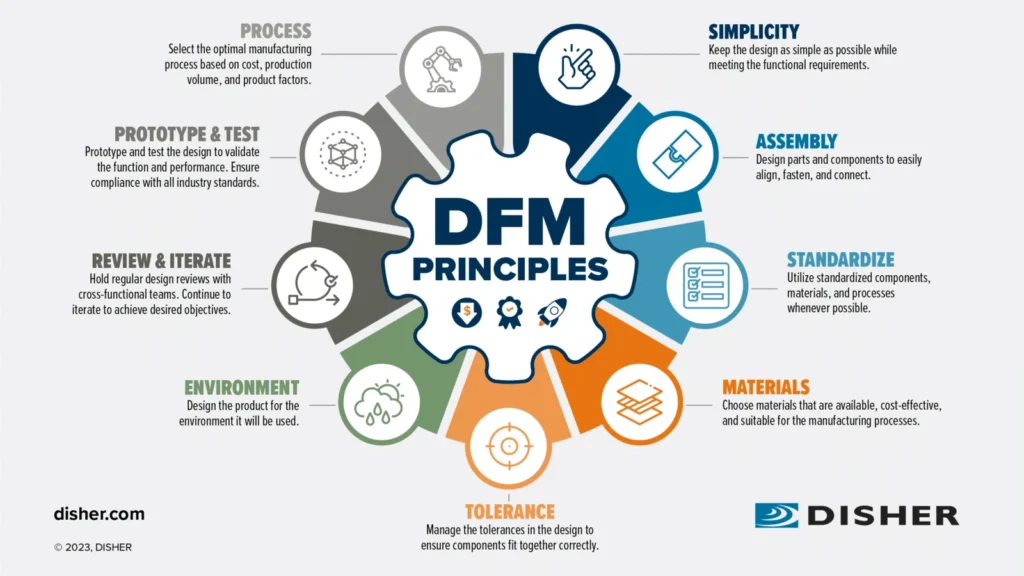
Source: https://www.disher.com/
Why DFM Matters
Design decisions drive the majority of manufacturing costs. Material choice, tolerances, part geometry, and process selection all have a big impact. Fixing issues at the design stage is always cheaper than fixing them later in production. DFM also improves product consistency and quality, especially at scale.
When Should You Use DFM?
Right from the beginning. Don’t wait until prototyping or quoting. Even rough design concepts should be evaluated with manufacturing in mind. Yes, some details—like ejector pin placement—can be finalized by toolmakers, but the overall design strategy should be aligned with production methods from day one.
DFM Tips by Manufacturing Process
Sheet Metal
- Choose the Right Tooling:
- Press-brake: Low tooling cost, fast setup, but slower per part.
- Progressive die: High tooling cost, long setup, but fast and consistent part output—best for high volume.
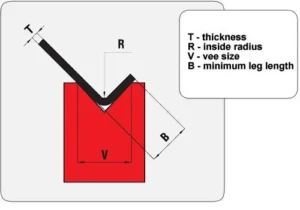
- Design for Foldability: If the part can’t be bent with standard tools, rethink it. Avoid designs that require internal flanges or inaccessible bends.
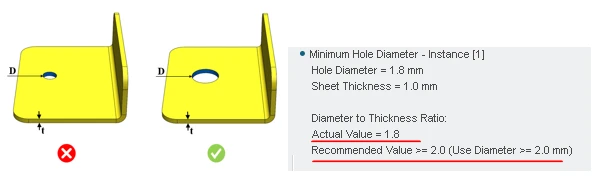
Source: https://dfmpro.com/blog/whats-in-dfm-sheet-metal-design
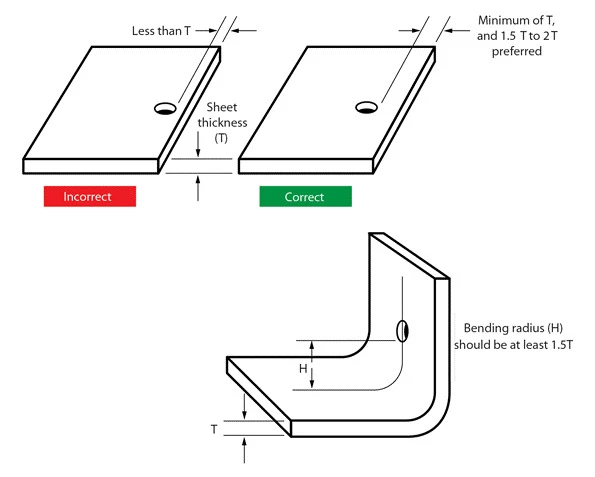
- Mind your spacing: Keep enough distance between bends, holes, and edges to avoid deformation. Closely spaced features can distort during forming.
Machined/Fabricated Parts
- Reduce setups: The fewer times a part needs to be re-fixtured, the cheaper it will be. Try to design parts that can be machined in a single setup.

Source: https://www.fiveflute.com/guide/cnc-machining-dfm-design-guidelines-for-milled-parts/
- Keep cuts in one direction: Machining from multiple angles adds time and complexity. Break up complex parts into simpler ones if needed.
- Smart material selection: Don’t over-specify. Harder materials are slower and more expensive to machine. Match the material to the application.
Injection Molded & Die Cast Parts
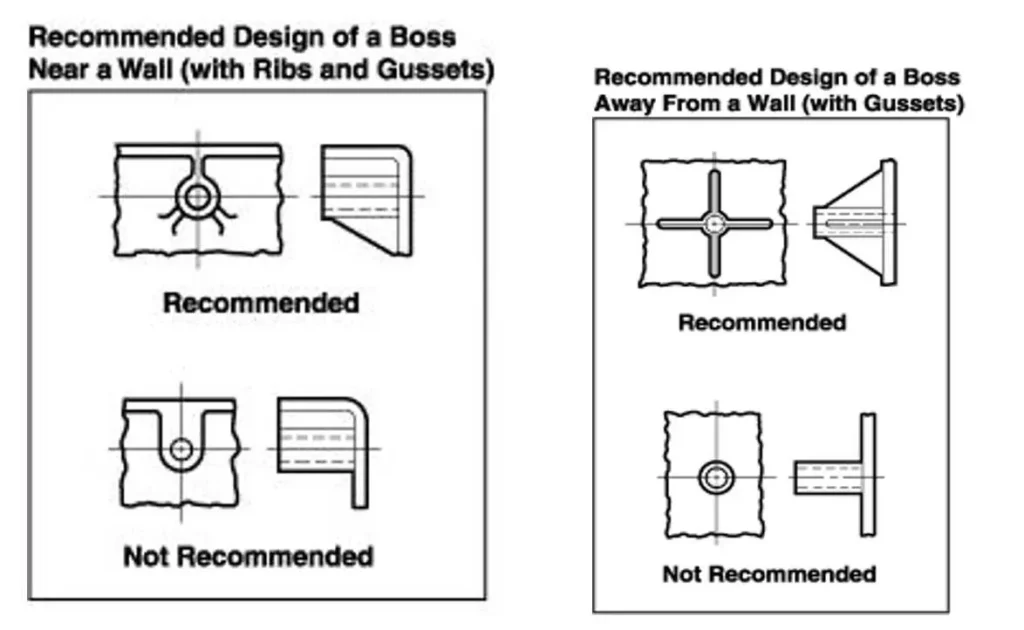
- Plan for tooling: Include space for parting lines, gates, and ejector pins. Ignoring these leads to expensive rework.
- Use proper draft angles: No draft = stuck parts. Use 0.5–3° for most surfaces, more if texture is involved.
- Avoid undercuts: If you don’t need them, don’t use them. They increase tooling costs and complexity.
- Account for material flow: Reinforced plastics behave differently depending on fiber direction. Don’t assume isotropic properties.
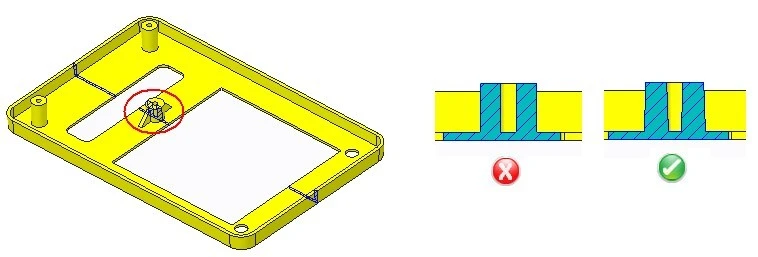
- Keep wall thickness even: Thick sections can cause warping, sink marks, and longer cycle times. Transition smoothly between thick and thin areas.
3D Printed Parts
- Respect process limits: Each printing method (FDM, SLA, SLS) has quirks—design accordingly.
- Plan orientation: Print direction affects strength, surface finish, and accuracy. A vertical hole isn’t the same as a horizontal one.
- Design for supports: Overhangs need support, which adds material and post-processing time. Minimize where possible.
- Avoid chunky sections: Thick parts can shrink or deform. Hollow out where you can.
DFM Success Comes from Experience
DFM isn’t something you learn once and forget—it’s a mindset built through practice. Peer reviews, supplier feedback, and prototype testing are key. At Tesla Mechanical Designs, we involve machinists, mold designers, and assembly techs early in the design phase. That way, our clients avoid common mistakes and get products that are ready for real-world production.
Our DFM Process at Tesla Mechanical Designs
We don’t treat DFM as a box to check—it’s built into our workflow. Our team works closely across disciplines to make sure each design is manufacturable, cost-effective, and reliable. Whether it’s a one-off prototype or a high-volume production run, we help our clients create smarter products by thinking about manufacturing from day one.
Need help with your product design?
We’re here to make sure it works—and that it works in production. Reach out to Tesla Mechanical Designs to learn more.
Talk to Experts