
Table of Contents
In the dynamic landscape of automotive engineering, the amalgamation of cutting-edge technologies has become the driving force behind unprecedented advancements in safety systems. One of the pivotal intersections is the synergy between Artificial Intelligence (AI) and Mechanical Design. We will explore the critical role these technologies play in improving car safety in this blog.
The Backbone: Mechanical Design Services
Mechanical design serves as the backbone of automotive safety systems. Through intricate planning and meticulous execution, mechanical design lays the foundation for the durability, functionality, and safety of vehicular components. Mechanical design services use cutting-edge technologies and techniques to make sure that each element within a vehicle is engineered to withstand real-world challenges and collisions.
Precision in Motion: 3D Product Modeling Services
At the forefront of this mechanical revolution is the prowess of 3D product modeling services. With the help of this cutting-edge technique, engineers can now produce complex virtual models of car parts, providing a three-dimensional understanding of their shape and functionality. This aids in a thorough comprehension of the design and provides a visual representation for improving and enhancing safety features.
The use of AI in safety systems is becoming increasingly prevalent as the car industry develops. The potential of AI to analyze massive volumes of data in real-time and make snap judgments is revolutionary for improving road safety.
Adaptive Cruise Control and Collision Avoidance:
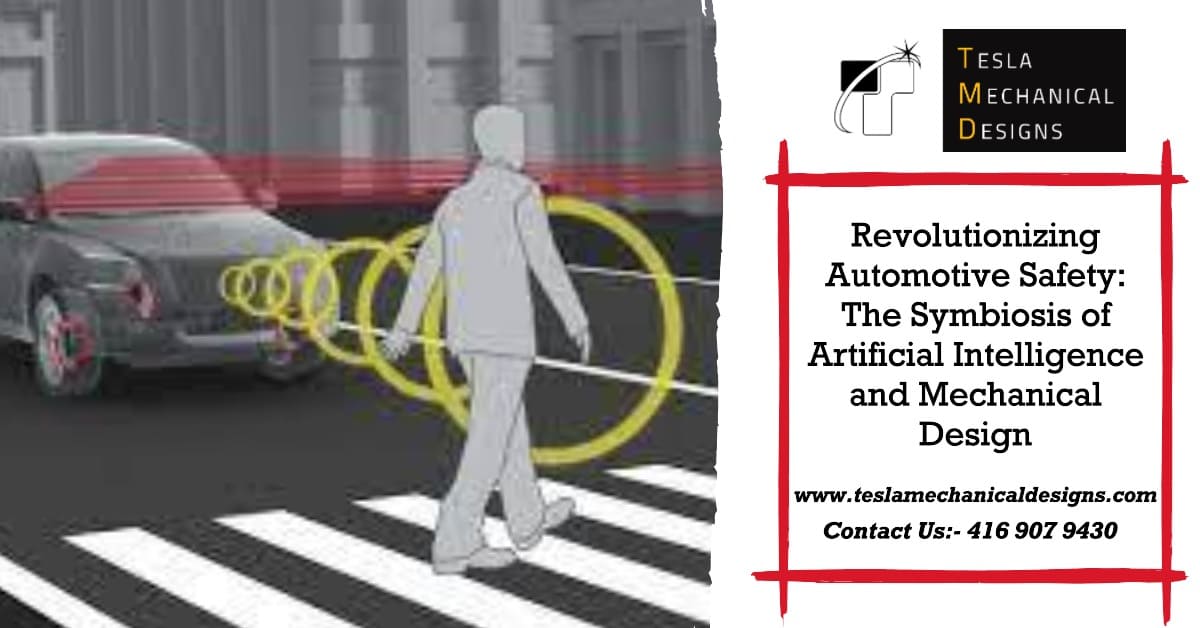
Adaptive cruise control and collision avoidance systems are two of the most notable uses of artificial intelligence in the automobile industry. These systems use sophisticated sensors and machine learning algorithms to scan the environment, anticipate possible collisions, and automatically change the vehicle’s course or speed to avoid them.
AI-Infused Emergency Braking Systems:
The incorporation of AI into emergency braking systems is a revolutionary development in automotive safety. These devices evaluate the likelihood of a collision using AI algorithms, and if required, they will initiate automated braking. This prompt and smart reaction lessens collision impact considerably, minimizing harm and damage.
Mechanical Design and AI Collaboration:
Mechanical design and AI can be integrated together to further streamline the manufacturing process and introduce better safety elements. Engineers can find possible design defects or weaknesses that could affect safety by using AI algorithms to examine data obtained from 3D product models. Stronger vehicle components and improved safety features are the end product of this iterative process, which is driven by both mechanical design accuracy and artificial intelligence.
The collaboration between AI and product design
AI systems are able to examine the details of three-dimensional models and forecast the behavior of individual parts in different scenarios. Predictive modeling helps engineers to foresee and handle safety issues before they materialize in the real world, which speeds up the design process.
Towards the Future: The Prospects for Automotive Safety
Future developments in the field of artificial intelligence (AI) and mechanical design in car safety systems promise to be fascinating. More advanced predictive modeling, real-time adaptive systems, and improved cooperation between AI and human engineers are all likely to be implemented in the development of cars that actively safeguard us as we travel.
AI-Powered Driver Assistance Systems:
AI’s influence extends beyond emergency situations; it seamlessly integrates into driver assistance systems, augmenting the overall driving experience. AI evaluates data from sensors and cameras to provide real-time insights that enable drivers to make wise decisions, such as lane departure alerts and blind-spot recognition. The integration of AI and mechanical design services results in a smooth integration of these support systems into the vehicle, improving its overall usability and safety.
Smart Materials and Structural Integrity:
AI’s involvement in improving structural integrity becomes increasingly important as we delve further into the fields of material science. Artificial intelligence algorithms are capable of analyzing mechanical simulation data and forecasting the behavior of various materials under stress and strain. With the help of this predictive capabilities, engineers may choose materials that not only adhere to safety regulations but also help with reducing weight and fuel economy, resulting in an automobile design strategy that is more comprehensive.
AI affects car interior design, putting user comfort and safety beyond external safety elements. AI promotes a user-centric approach to safety, from intelligent cabin controls that anticipate driver demands to adaptive airbag deployment depending on passenger characteristics. In order to ensure that these AI-driven elements blend in smoothly with the vehicle’s architecture and balance usefulness and aesthetics, mechanical design services are essential.
Conclusion
The integration of AI and mechanical design services is an indication of how innovation is advancing safety in the automobile sector. The significance of these technologies in developing robust and secure automotive systems cannot be emphasized as we enter the age of intelligent automobiles. The future where accidents are reduced and safety is of utmost importance is being ushered in by the harmonic blending of AI’s cognitive powers with the precise craftsmanship of mechanical design services.