
Table of Contents
Product Design Services involve taking a design idea and converting it into a physical 3D prototype. It can be done by a variety of methods like injection molding, subtractive manufacturing, etc. One prominent method that has gained popularity in recent times has been 3D printing. It is a method of creating a 3D object layer by layer using a computer-created design. It is also known as additive manufacturing because layers of materials are essentially built up in order to create a product. Today, a variety of industries across different sectors are adopting 3D printing as its main advantages are realized in its flexibility, speed, and cost.
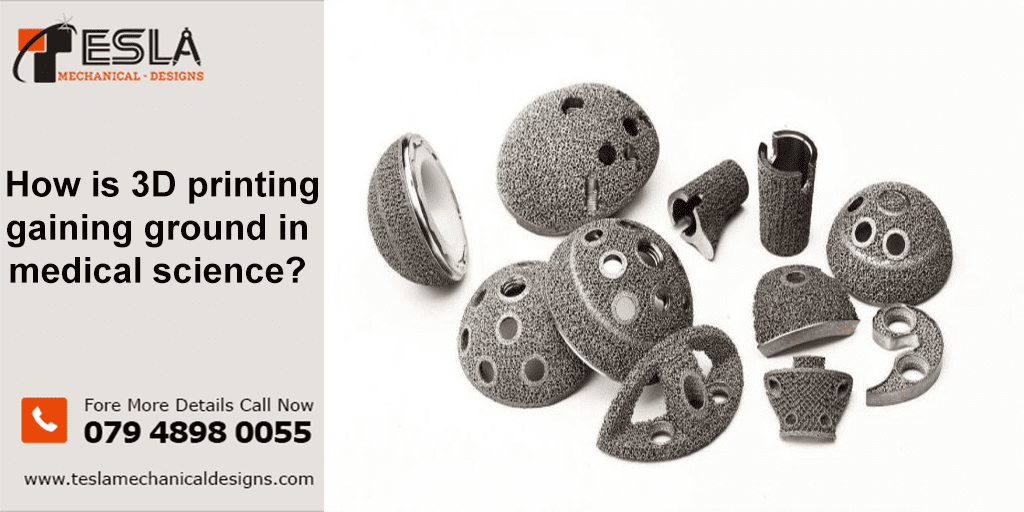
When it comes to the medical sector specifically the last five years have seen significant growth in the adaption of 3D printing. Medical uses for 3D printing involve the creation of customized prosthetics, tissue and organ fabrication, and the creation of implants as well as benefits pharmaceutical research.
3 major issues are addressed by 3D printing in medical field:
Currently, there are three problems that are being faced by clinicians. Firstly, it is extremely time-consuming to customize pre-surgical planning models. Secondly, the anatomical features that are specific to a given patient can only be precisely identified in a digital model. Finally, when implants have to be shaped during the surgery then it can be extremely time-consuming. These issues can be addressed by 3D printing. With additive printing, it is possible to fabricate real-size surgical models based on CT scans. They can help during the planning of surgery leading to better and more successful procedures. These physical and anatomical models also enable improved communication allowing the patients to properly understand their conditions as well as the procedures they will be undergoing. They are finally even responsible for shorter surgeries as implants, prosthetics, etc. can all be well planned in advance.
Workflows and customized medical devices:
The workflow for 3D printing in the medical sector can be as follows:
Step 1: Scan the patient’s anatomy. In this step data regarding the patient is collected via CT or MRI scan. In the case of a tissue, a DICOM file is obtained.
Step 2: The scans are reviewed following which 3D Modeling Services are utilized to create 3D printable models.
Step 3: Upload the digital file to the 3D printing software subsequently physical, real-size anatomical models are 3D printed.
Step 4: Following 3D printing support removal, rinsing, and post-curing can take place. They can then be utilized for the requisite purpose like pre-surgical planning, explaining the procedure to patients, research, etc.
3D printing today for medical products is so specialized that it can be used according to specific requirements. In cardiac surgery, it can be utilized to create conduit bypass models, coronary fistulas, hypoplastic hearts etc. In neurology, 3D printing can be used for creating Skull- and brain-based (glioma), tumors, cerebral aneurysms etc. Even foot, ankle, shoulder, hand, limbs etc. all be 3D printed. The scope of 3D printing in medicine is constantly expanding and as new research comes to the light it can be said that to a great extent it is only limited by the imagination of the individual.
Advantages of 3D Printing In Medical Applications:
With 3D printing, it is possible to create medical equipment and products that are required. It involves fixtures and tools that would be utilized for use in operating rooms to custom-made implants that are needed for a specific surgery or procedure. Moreover, all these items can be produced in a quick timeframe and in an affordable manner. Traditional methods are fine when it is for large-scale production however, they can become more expensive when it comes to small and unique products. Since they don’t need to be mass-produced 3D printing can be extremely advantageous. Similarly, these designs might also require a lot of modifications and it could become extremely time-consuming to go to a production facility. This would take days if not weeks while 3D printing on the other hand might only take a few hours. Finally, as 3D technologies evolve they become more reliable, accurate, and durable ultimately, increasing their importance in the medical sector.