
Table of Contents
The current period in the human history can be defined by its ever increasing concern for the climate change and global warming. One of the biggest contributors to climate change are the traditional vehicles running on non-renewable resources like petrol, diesel etc. In a traditional vehicle combustion of fuel in the internal combustion engine releases exhaust gases like Carbon Dioxide(CO2), Carbon Monoxide(CO) and other hydro carbons that are toxic and carcinogenic causing air pollution. It is in these times that electrical vehicles can be extremely beneficial.
How do electric vehicles work?
The traditional engine generates power by burning a mix of fuel and gas while an electric vehicle operates on electric motor. This is perhaps why EVs are being seen as a possible replacement for the current generation automobile.
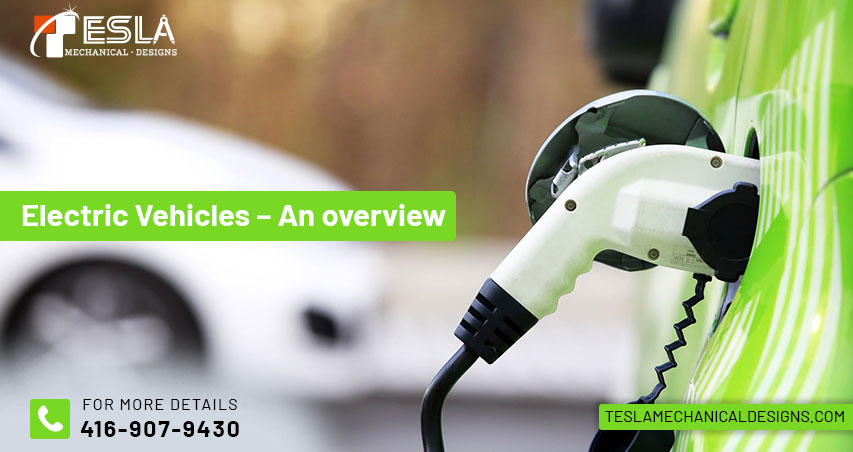
The electric cars need to be plugged into a charge point. Following which they take the electricity from the grid which can be stored in rechargeable batteries that power the electric motor. They have advantages which are not available in the internal combustion engine vehicles as they react quickly, have more torque and are very responsive. In order to charge the electric engine, they can be plugged into a public charging station or they can be charged at home.
What are the inner parts of an Electric Vehicle?
Today, Machine Design Services can be used to effectively design an Electric Vehicle. When compared to ICE(Internal Combustion Engine) cars, electrical vehicles has 90% less moving parts. Below is a breakdown of the parts of the EV:
- Electric Motor: The electric motor converts the electrical energy into mechanical energy and it provides the power to rotate the wheels.
- DC-AC Convertor: The DC(Direct Current) which is supplied by the battery converter needs to be converted to AC(Alternate Current) and then it is supplied to the electric motor. This is managed by a sophisticated motor control mechanism which controls the frequency and magnitude of the voltage supplied to the electric motor so the speed and
acceleration can be managed as per the driver’s instructions. - Drivetrain: Electronic Vehicles have single speed transmission that sends power from the motor to the wheels.
- Batteries: They store the electricity which is required to run an EV. Higher the Kw of the battery the higher is its range.
- Charging: It can be plugged at an outlet or EV charging point.
The range of the electronic vehicle is different is each model and depends on the battery size and efficiency. There are a few types of electric vehicles like some run purely on electricity while some are hybrid and can run petrol or diesel as well.
- Plug-in electric: They are powered solely by electric battery as they have no gas or engine parts. They get all their power when they are plugged into charge. Since they don’t use fuel they don’t have any emissions.
- Plug-in hybrid: These mostly run on electricity but they also have a fuel engine like traditional vehicles so that it can be run on petrol and diesel too. It runs on electricity when it is charged and when the battery runs out it switches to fuel to run. It has emissions only when it is running only on fuel.
- Hybrid-electric : They mainly run on fuel but also have an electric battery which is charged through regenerative breaking. With the touch of a button the user can shift from using fuel to “EV” mode. These cars can’t be connected to an EV source and rely on petrol and diesel for energy.
There are a variety of advantages of using electric vehicles. Firstly, they are cheap both to run and maintain. The cost of electricity used to charge an EV is 40% less than the amount it would take to use petrol. Finally, they are extremely good for environment and in a time where the rising population, depletion of natural resources and global warming are the key concerns, EVs could end up being the perfect solution.